

Decentralized knowledge & professional development for providers: physiology, wellness, yoga teaching, diseases, pharmaceuticals, more. How human-led, real-world tools maximize the potential of AI.
See for yourself what becomes possible when knowledge is organized, contextualized, and designed for navigation — not just generated on demand from a centralized system.


Contents
Hubs: Turning Information into Guided Pathways
The Corruption of Centralized Education & Professional Development, and the Solution: Decentralized Learning & Sharing
Using AI for What it’s Good For, Not for What it’s Not
Own the Framework, Use the Tool: A Smarter Approach to AI
Hubs: Take a Look
Boost Your Impact — Premium Resources Just a Click Away from $19
Recent Newsletters
Hubs: Turning Information into Guided Pathways

Imagine walking into a massive transit hub, like Grand Central Station. Trains are arriving and departing, people are navigating toward different destinations, and everything is connected through a clear underlying system. Despite the scale, it’s not chaos — it’s structured flow.
That’s exactly what our “hubs” are: not just a collection of information, but a curated, organized environment where everything has a place, a purpose, and a path forward.
What makes hubs powerful isn’t just organization — it’s intentional navigation.
Each section acts like a platform, each link like a track, guiding you toward deeper understanding or action. You’re not just receiving information — you’re navigating it.
Here’s how that metaphor translates:
The main hall is your foundational overview. It orients you quickly—what this topic is, why it matters, and what directions you can go.
The platforms are structured subtopics. Each one leads to a different “destination” depending on what the user needs.
The schedules and signage are your guidance systems—clear pathways, recommended next steps, and contextual cues that prevent overwhelm.
The trains are the deeper dives: resources, tools, case studies, and applications that move someone from curiosity to mastery.
AI can generate answers, but it often lacks:
continuity,
prioritization,
and a sense of journey.
A hub fills that gap. It provides:
context (how things connect),
foundation (what matters most first),
and direction (where to go next).
Lots of people go to this place (just as lots of people go online), but they each have different needs. Some have to get to a train going north; some are going south. Some have been here a hundred times; for others, this is their first visit. Some are in a rush, and they need the most direct pathway. Others have more time and want to study maps to get a visual sense for where they’re going. Some are embarking on a long journey and need guidance to determine which trains connect to others in order to get where they’re heading. Some want to spend time admiring the architecture of the transit hub itself.
From the hub, people get a sense for their options, which are many — far more than they imagined before they arrived. They can efficiently choose according to their current need. There are a million details available about which trains go where and when, but from the hub, you’re in control of which details you choose according to your priorities. The hub provides a sensible and visual perspective that shows you more options than you knew existed and hadn’t thought to ask about. Even if you haven’t gone down that hall over there, it goes somewhere you’ve always wanted to visit or may need to visit in the future, and now you know how to get there when the time comes.
When you already know which door takes you to the train you need, but you arrive early, then you can choose to spend more time investigating related routes, talking with travelers, or taking in the sights. After you’ve done such meandering and investigating, you’ll likely find that the knowledge and experience enriched you and that you’re inspired to help others to appreciate the grandness of the options. You find that you’ve gained more knowledge about more practical considerations and that this grants you a spacious perspective. You now have the experience, patience, and capability to help more people who may be in a rush to get the detailed directions they need quickly.
The Corruption of Centralized Education & Professional Development, and the Solution: Decentralized Learning & Sharing

To bring the metaphor full circle, revered educational institutions once functioned like masterfully designed transit hubs — both beautiful and effective. They helped people map their journey toward becoming skilled, credentialed professionals, and guided them to the right trains: courses, clinical experiences, and degrees that moved them forward with purpose.
But centralized systems are vulnerable to corruption. Over time, we’ve inherited a verifiably corrupt medical system that uses an immoral business model, has abandoned evidence-based decision making, and routinely uses testing and “treatments” that cause harm. The safeguards our predecessors put in place — regulatory agencies meant to protect the public — have become arms of industry, betraying humanity at every turn.
So now we find ourselves at a new frontier—one that calls for a new metaphor.
Instead of well-defined railways, we’re navigating terrain that requires us to build and choose our own roads. Institutions that once served as trusted guides now funnel people onto five-lane freeways that promise speed but deliver congestion, confusion, and, too often, fast lanes to nowhere.
To reach where we actually want to go, we have to take a different path. Fortunately, we’re not alone. Many others have already stepped off the pavement. If we pause and look around, we begin to notice where the brush has been cleared. What first appears as uncertainty reveals itself as possibility — emerging trails shaped by those who came before us.
Some paths are dead ends, yes. But others lead somewhere meaningful: a clear stream, a nourishing resource, a breathtaking vista that reminds us why we started. Along the way, we find well-worn tracks — paths quietly used for years, now gradually widened by a growing community. We meet fellow travelers who share insights, warning of us of where the ground gets muddy and where a fork in the road leads to something unexpectedly valuable. And soon, we trust our direction. The appeal of those endless miles of asphalt — of going nowhere, faster — fades completely as we enjoy the successes of being on the right path going in the right direction.
This realization shaped my own journey. When I discovered that I could learn more from independent experts than from many established sources, I turned by passionate focus from traditional education to self-directed learning and professional development. In 2011, I asked colleagues if they would value a centralized space to curate and organize these resources. The response was encouraging—but truthfully, I was going to build it regardless. I needed it.
What began as a personal solution — a kind of legacy project — became something much larger. It gave me a reason to dive deeply: to collect hundreds of books, to research relentlessly, to connect ideas across disciplines. That work evolved into my full-time focus, and today lives on through platforms like WellnessResourceCenter.net and YogaTeacherCentral.com — modern hubs designed to help others navigate their own path with greater clarity, context, and confidence.
Using AI for What it’s Good For, Not for What it’s Not

The knowledge pathways within Wellness Resource Center hubs are the result of thousands of searches conducted over decades, including extensive use of AI in the past year.
I use AI regularly to answer certain types of questions, and in many cases, it performs exponentially better than today’s heavily manipulated search engines. But I’ve also observed consistent pitfalls, blind spots, and risks, and learned how to navigate around them. My observations and responses come from a lifetime of watching how large-scale technologies are introduced, shaped, and ultimately controlled.
I first encountered this trajectory back in 1978, in a junior high typewriting class, when electronic typewriters replaced manual ones. From there, I saw the first classroom computers arrive at my high school in Anchorage, Alaska in the early 1980s. In college, I worked on a “dumb terminal” connected to a room-sized mainframe system, overseen by a dedicated technician. Not long after, I discovered spreadsheets — at the time, a genuinely transformative tool.
In the early 1990s, while working at Microsoft, I witnessed the rollout of DOS 5.0 and Windows, along with the standardization — and monopolization — battles that followed. Then came widespread access to the World Wide Web. Then smartphones. Then everything after that.
After decades of being closely involved in the evolution of digital information systems, I’ve become deeply invested in identifying what genuinely helps — and what leads to dead ends. For real people in the real world, using technology to support growth, health, and meaningful work is more complex than it appears. We’re navigating tools that are powerful, but not neutral.
The impact is impossible to ignore. The rapid shift in how people live — especially children — since the rise of smartphones and social media has been, in many ways, devastating to witness.
And yet, the same internet that has introduced distraction and distortion has also sparked a widespread awakening. It has given people access to knowledge, perspectives, and connections that were once unimaginable. It has empowered individuals to question, to learn independently, and to build something better.
That tension — between manipulation and empowerment — is exactly why our work and our hubs matter. Hubs provide a grounded, intentional way to navigate an increasingly complex landscape. Not by rejecting technology, but by using it wisely — anchored in context, guided by experience, and designed to help providers move forward with clarity and purpose.
Own the Framework, Use the Tool: A Smarter Approach to AI
Like all technology — no matter how advanced — AI comes with critical limitations: built-in assumptions, constraints around scope, and issues of control and access.
It is not as comprehensive or as reliably sourced as it often appears.
For some subjects, AI delivers genuinely useful, even excellent answers.
But in other areas — particularly those that are sensitive, controversial, or shaped by powerful incentives — it can misdirect, omit, or distort information.
In certain cases, if you already know what to look for, you can guide it toward valuable insights. In others, it may confidently provide incorrect or incomplete answers. Testing it against topics you already understand can quickly reveal these inconsistencies.
I’ve encountered situations where AI initially offered information, then reversed course and claimed it was too dangerous to share. In one instance, it refused to provide a list of publicly convicted individuals for a specific category of crime, suggesting that doing so could cause harm. That kind of response makes one thing clear: this is a controlled system — and what is accessible can shift based on rules we neither see nor influence.
This raises an important question: who defines those boundaries, and how are those decisions made? AI may surface certain types of research or perspectives now, and restrict them later. The system is dynamic, and its oversight is not neutral. Access today does not guarantee access tomorrow.
It’s also worth asking what made AI feel so intuitive and “friendly” in the first place.
Its ability to understand natural language, mirror tone, and engage conversationally didn’t emerge in a vacuum. It was built on vast amounts of human-generated data — patterns of speech, behavior, preferences, and interactions collected over many years.
That reality brings its own set of questions. How was that data gathered? To what extent did people knowingly contribute to it?
And how is it now being used — not just to inform, but to shape behavior, automate roles, and influence decisions?
None of this means AI is inherently harmful. It can be an extraordinarily powerful tool. But like any tool, its value depends on how it’s used — and how much we rely on it.
The more subtle risk isn’t just misinformation; it’s overdependence.
When individuals or businesses build entirely on systems they don’t control, they become vulnerable to shifts in access, policy, or direction. What seems efficient in the short term can create fragility over time.
That’s why intentional use matters.
We can choose to use AI the same way we approach any other technology: as a support system, not a substitute for judgment, experience, or independent thinking.
And just as importantly, we can invest in building our own frameworks — our own “hubs” — so that we’re not entirely dependent on systems that can change without notice.
Otherwise, we risk stepping back onto that five-lane freeway — moving quickly, but in a direction we didn’t choose.
Hubs: Take a Look

Our visual hubs support providers in their research, study, and preparation. These reference portals open up worlds of knowledge, but in an organized way that allows you to direct your path.
For example:
Anatomy & Physiology hub link
Health Education, Adaptation & Conditions hub – Diseases, injuries, customizing for the individual link
Yoga Teaching Methodology hub link
Pharmaceuticals, Drugs & Vaccines hub link

And then what? What happens when you click links? You arrive at organized “lessons” that let you continue to self-direct. For example, let’s say you’re scanning the Health Education hub, and realize you want to dig deeper into the physiology of sleep:

When you select a subject, you arrive at the lesson where you can see the scope at a glance and use quick links to view related lessons.

In this case, the related issues are Techniques for Sleeping Issues, Yoga & Sleep, and a summary list of 191 sources in alpha order by author with quick links to dig deeper if desired.
If you want to stay with this lesson, you can use the contents to jump directly to what you want:
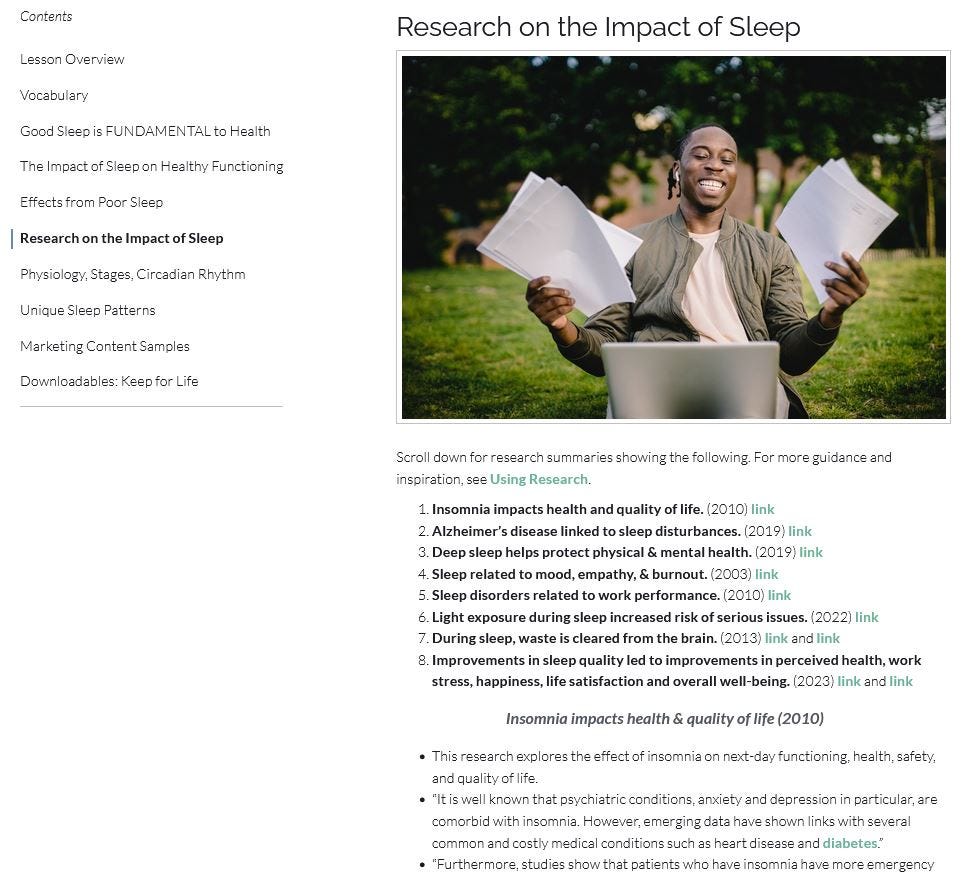
Downloadable versions available. Here’s a sample PDF. Associate and Trainer members get it in customizable DOC format with royalty-free distribution rights:
Boost Your Impact — Premium Resources Just a Click Away from $19

Since 2012, Wellness Resource Center and Yoga Teacher Central have been supporting teachers and wellness providers. We’re here for the helpers — yoga teachers, health providers, trainers, coaches, and educators who empower others.
High-quality resources are just a click away: planning tools, research summaries, lesson frameworks, wisdom teachings, structured workshops, and ready-to-use content. Whether you’re planning a class or workshop, educating clients on anatomy, inflammation, energy, meditation, or the root causes of over 50 diseases, guiding breathwork, strength-building, or relaxation, designing a training, or compiling research that backs up your teachings, we’ve got you covered. Our resources elevate your work and amplify your impact, giving you the confidence and time to focus on being present and doing what you do best.
We Provide
Evidence-based resources, delivered in context and designed for real-world application.
Flexible knowledge base with guided pathways to support your evolving learning and service goals.
Practical support for workshop and training delivery, including content, lecture notes, and handouts.
Personalized support to focus your efforts, maximize your time, and amplify your impact.
Collaborative, values-aligned community for connection, inspiration, and learning.
How Can We Help You Today?
Verifiable research on evidence-based therapies and tools? ✔
Contextualized guidance to individualize your services? ✔
Curricula for trainings, workshops, coaching, and client consultations? ✔
Customizable content with lifetime, royalty-free distribution? ✔
Packages & Pricing
Select from two membership tracks:
Providers and Teachers — Access evidence-based education, research, and resources to support your planning and preparation for teaching, coaching, and consulting. Pricing starts at $19/month (annual pay) or $23/month (installment pay).
Associates: Trainers, Consultants, Educators — Includes all Provider benefits plus customizable content and lifetime, royalty-free rights to distribute materials for trainings, courses, workshops, series, presentations, and consultations. Flexible credit-based pricing lets you select exactly what you need from 500+ subjects. Pricing starts at $400 for content and lifetime distribution rights.